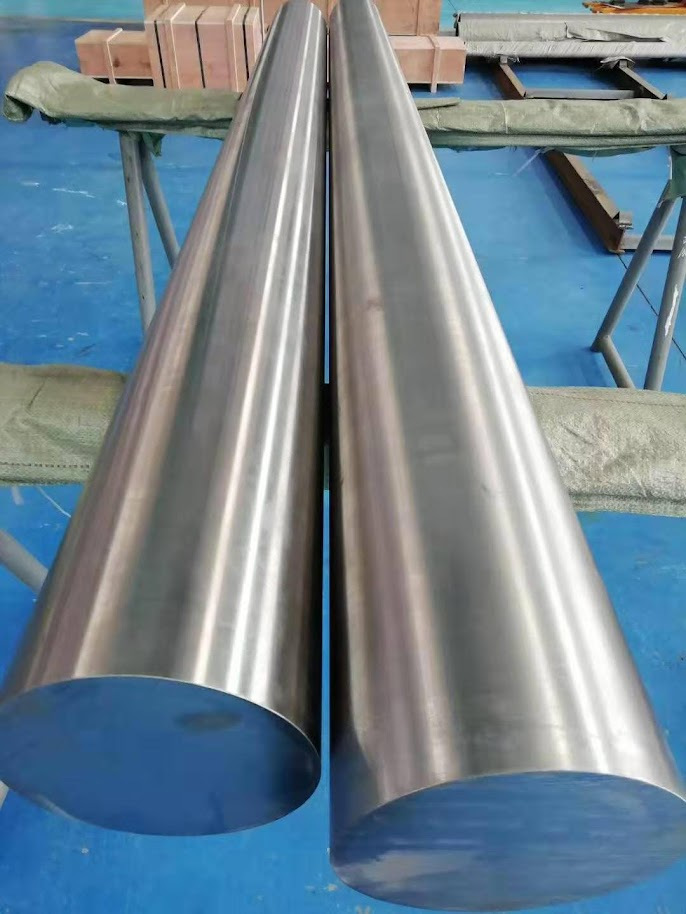
Titanium Electrode Rod Production Capability
- Ti Production Standards: ASTM B348, ASME SB348,
- Ti Grades: Gr 1, 2, 3, 4, 5 (6Al-4V), 6, 7 (Ti-0.15Pd), 9 (3Al-2.5V), Grade 12, 23 (6AL-4V ELI) (6Al
- Ti Electrode Rod Dimensions: Diameter 8 – 400 mm
- Ti Electrode Rod Shapes: Custom Designed
- Ti Electrode Rod Surface Finishes: Polished
Standard Titanium provides titanium electrode rod for use in the Plasma-Rotating Electrode Process (PREP).
Dimensional Tolerances for Titanium Bars
The table below details the differing diameter tolerances for the differing lengths of titanium bar. These are aligned to internationally recognised engineering standards. The differing production methods define the range of diameters for each approach. All titanium rod dimensions and tolerances are agreed ahead of order.
| Specified Size, in. (mm) | Size Variations,
in. (mm) | Out-of-Round / Out-of-Square
in. (mm) |
| 1⁄4to 5⁄16 (6.35 to 7.94), incl | +/-0.005 (0.13) | 0.008 (0.20) |
| Over 5⁄16 to 7⁄16 (7.94 to 11.11), incl | +/-0.006 (0.15) | 0.009 (0.23) |
| Over 7⁄16 to 5⁄8 (11.11 to 15.88), incl | +/-0.007 (0.18) | 0.010 (0.25) |
| Over 5⁄8 to 7⁄8 (15.88 to 22.22), incl | +/-0.008 (0.20) | 0.012 (0.30) |
| Over 7⁄8 to 1 (22.22 to 25.40), incl | +/-0.009 (0.23) | 0.013 (0.33) |
| Over 1 to 11⁄8 (25.40 to 28.58), incl | +/-0.010 (0.25) | 0.015 (0.38) |
| Over 11⁄8 to 11⁄4 (28.58 to 31.75), incl | +/-0.011 (0.28) | 0.016 (0.41) |
| Over 11⁄4 to 13⁄8 (31.75 to 34.92), incl | +/-0.012 (0.30) | 0.018 (0.46) |
| Over 13⁄8 to 11⁄2 (34.92 to 38.10), incl | +/-0.014 (0.36) | 0.021 (0.53) |
| Over 11⁄2 to 2 (38.10 to 50.80), incl | +/- 1⁄64 (0.40) | 0.023 (0.58) |
| Over 2 to 21⁄2 (50.80 to 63.50), incl | + 1⁄32, − 0 (0.79) | 0.023 (0.58) |
| Over 21⁄2 to 31⁄2 (63.50 to 88.90), incl | + 3⁄64, − 0 (1.19) | 0.035 (0.89) |
| Over 31⁄2 to 41⁄2 (88.90 to 114.30), incl | + 1⁄16, − 0 (1.59) | 0.046 (1.17) |
- Out-of-round is the difference between the maximum and minimum diameters of the bar, measured at the same cross section.
- Out-of-square section is the difference in the two dimensions at the same cross section of a square bar, each dimension being the distance between opposite faces.
Shaanxi Standard Titanium Industry Co., Ltd. manufactures titanium electrode bar for use in melting, remelting and downstream titanium production. Production is controlled to maintain consistent chemistry, cleanliness, dimensional accuracy and traceability, with standard and custom sizes available to suit different furnace and processing requirements.
Electrode bars can be produced using forged or rolled processing routes depending on alloy, section size and end-use requirements. Material condition, surface preparation and dimensions are controlled to support reliable electrode assembly and stable melting performance.
Since 2010, Standard Titanium has supplied titanium electrode bar in commercially pure and alloy grades in accordance with applicable international and customer specifications. Quality control is applied throughout the production route, including material identification, heat traceability, dimensional inspection and verification of chemical and mechanical properties where required.
- Electrode bar is available in a range of diameters, lengths and alloy grades for titanium melting and remelting applications.
- Production routes and surface condition are selected according to the required furnace process, alloy and specification.
- Each order is produced under controlled quality procedures with full material traceability and the relevant certification and inspection documentation.
Stringent Quality Assurance process is the competitive advantage and is at the heart of everything. Highlights of the QA process are:
- Dedicated service management QC system to control quality from raw material sponge to mill product and every process step in the production of titanium.
- “Product Quality Certificate” and inspection reports with every order.
- Maintenance of a controlled stock inventory to enable fulfilment of orders in short time periods.
- English speaking work environment and have exported products for many years, this ensures there is no misunderstand or requirements or manufacturing approaches.